marketing strategy isn’t working

Your Marketing Isn’t Broken. It’s Just Solving the Wrong Problems

If your marketing strategy isn’t working the way you expected, if it feels inconsistent, harder than it should be, or strangely exhausting, it’s rarely because you’re doing nothing.

Most companies at this stage are doing a lot.

They publish content.
They run campaigns.
They test tools.
They hire agencies or freelancers.
They invest time, money, and attention.

And yet, despite all this activity, a quiet question lingers in the background:

Is this actually working?

Not in the superficial sense of clicks or impressions, but in the deeper sense of clarity.

What’s working because of what?
What should be doubled down on?
What should be stopped?
What actually moves the business forward at this stage?

When teams ask these questions, it’s usually not because marketing is failing.
It’s because something underneath isn’t aligned.

Table of Contents

Blog Newsletter

The Problem Isn’t Effort. It’s Alignment

When marketing feels heavy or confusing, the instinctive reaction is to do more.

More content.
More campaigns.
More channels.
More tools.

That reaction makes sense. It’s rational. And in many cases, it’s exactly what’s expected.

But effort doesn’t fix a misaligned system.

In fact, when the underlying structure of a marketing strategy is unclear, effort tends to amplify the wrong things.

Teams stay busy, but progress feels elusive.
Decisions take longer;  not because people are careless, but because nothing clearly stands out as the priority.
Every new initiative feels plausible, and therefore hard to say no to.

This is usually the moment when marketing starts to feel random.

And when marketing feels random, it’s rarely because people don’t care.
It’s because the order is wrong.

Activity Is Not the Same as Progress

One of the most misleading ideas in modern marketing is that visible activity equals momentum.

Posting regularly feels like progress.
Launching campaigns feels like progress.
Adding tools feels like progress.

But progress isn’t about motion. It’s about direction.

Without a clear understanding of which problems should be solved at this stage, marketing becomes a collection of reasonable actions that don’t quite add up.

This is where many growing companies get stuck.

They are not failing.
They are not behind.

They are simply solving problems that don’t match their current level of maturity.

Why Good Advice Often Makes Things Worse

Here’s an uncomfortable truth most teams don’t hear often enough:

A lot of marketing advice is correct; just not for you, right now.

Advice is usually given as if all companies share the same context, the same constraints, and the same readiness. In reality, they don’t.

Some problems only make sense to solve once certain foundations exist.
Some tactics only work when systems are already in place to support them.
Some strategies create leverage, but only after clarity is established.

Applying the right solution at the wrong stage doesn’t just fail to help.

It creates new problems.

Over time, this doesn’t just waste budget.
It teaches the organization the wrong habits, reinforces confusion, and makes future decisions harder, not easier.

The Hidden Cost of Staying Misaligned

Most teams underestimate what staying in this state actually costs them.

Not just financially, but cognitively.

When structure is missing:

  • Every initiative feels equally urgent
  • Priorities compete instead of reinforcing each other
  • Data becomes harder to interpret
  • Confidence in marketing slowly erodes

People stop asking, “What’s the next right problem to solve?”
They start asking, “What should we try now?”

Over time, effort compounds inefficiency, not growth.

The Shift That Changes Everything

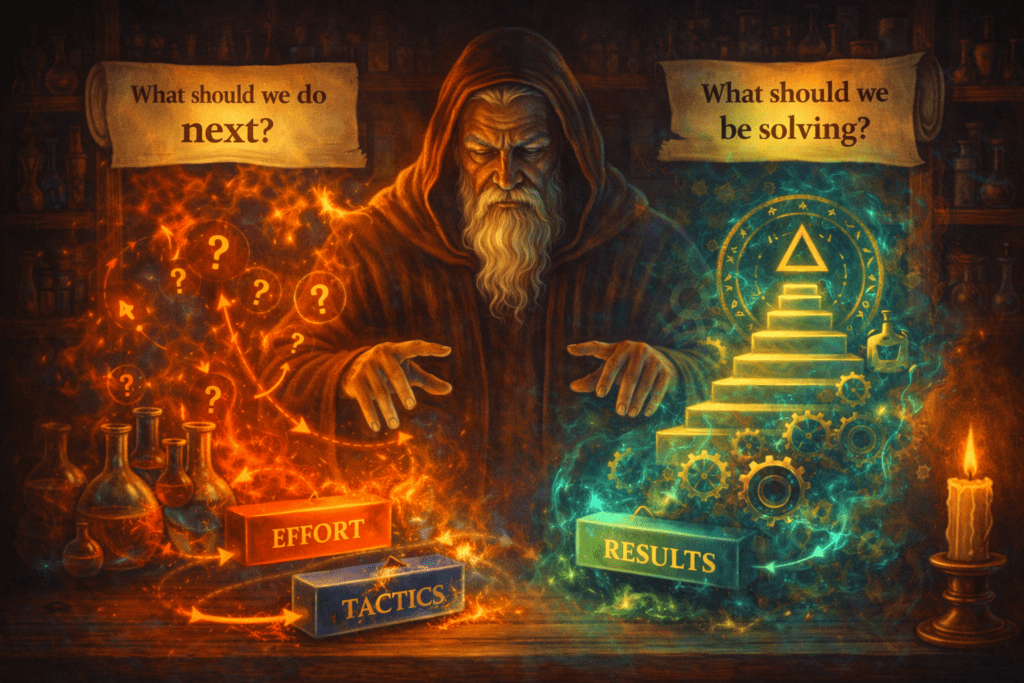
The turning point usually comes when a company stops asking:

What should we do next?

…and starts asking:

What kind of problems should we even be solving at this stage?

That single shift reframes marketing from a collection of tactics into a system.

It introduces sequencing.
It creates clarity.
It makes saying no easier.

And most importantly, it restores confidence, not through motivation, but through understanding.

Growth doesn’t come from doing more.
It comes from doing the right things, in the right order, for where you actually are.

Where This Leads Next

Once this lens is in place, marketing stops feeling overwhelming.

Not because there’s less to do, but because it becomes clear what actually matters now.

That clarity is where the real work begins.

Why Different Stages Require Different Problems

At a certain point, doing the “right things” stops being helpful if those things aren’t right for where you are.

Adding channels before clarifying priorities.
Scaling campaigns before understanding what actually works.
Measuring everything without knowing which decisions the data should inform.

None of these actions are wrong in isolation.

They are simply out of sequence.

When sequencing is off, marketing doesn’t fail loudly, it fails quietly.

Progress slows.
Confidence erodes.
Teams compensate by adding more effort instead of more clarity.

Why Advice Feels Conflicting (And Why That’s a Clue)

Many teams describe marketing advice as contradictory.

One expert says focus on brand.
Another says performance.
One says content first.
Another says ads.

The issue isn’t that someone is wrong.

It’s that each recommendation assumes a different stage of maturity.

Advice only works when it matches the problems you should be solving right now.

For companies in this phase, the real risk isn’t choosing the wrong tactic.
It’s choosing the right tactic too early, or too late.

The Compounding Cost of Guessing

Most teams don’t intentionally ignore structure.

They guess.

They estimate where they think they are.
They infer readiness from activity.
They assume momentum where there is mostly motion.

That guess becomes the foundation for what gets prioritized, funded, and postponed.

Every decision built on a guess compounds its consequences over time.

At first, this feels manageable.
Later, it becomes expensive, not just financially, but organizationally.

Marketing starts to feel like something that must be endured, rather than leveraged.

From “What Should We Do?” to “What Should We Be Solving?”

There is a moment in most growing companies when the question quietly changes.

It stops being:

What should we do next?

And becomes:

What kind of problems should we even be solving at this stage?

That shift doesn’t simplify marketing by reducing effort.
It simplifies marketing by restoring sequence.

Clarity replaces urgency.
Decisions feel lighter.
Focus becomes possible again.

Growth doesn’t accelerate when you do more.
It accelerates when you stop solving the wrong problems.

Where the Maturity Lens Comes In

This is where a maturity lens becomes useful, not as a framework to memorize, but as a diagnostic tool.

Not to label companies.
Not to judge capability.
But to clarify what actually matters now, and what doesn’t.

If you want to explore how these stages are defined in more detail, you can read
The 5 Levels of Digital Marketing Maturity.

But understanding the model isn’t the first step.

Knowing where you actually stand is.

Removing the Guesswork

Marketing Maturity Assessment

Most teams assume they know their level.

Sometimes they’re right.
Often, activity masks gaps — or creates false confidence.

Guessing feels harmless, until every strategic decision depends on that guess.

That’s why we built a short assessment.

Not to score performance.
Not to sell services.
But to remove ambiguity.

Before investing more time, budget, or energy, it helps to know which problems you should actually be solving right now.

Find Your Marketing Level – 3-minute assessment

Clarity Before Action

At a certain point, marketing stops being a question of effort.

Most teams don’t struggle because they lack ideas, tools, or ambition.
They struggle because they are operating without a clear sense of what actually matters now.

When structure is missing, everything feels important.
When structure is clear, priorities emerge naturally.

Marketing becomes lighter, not because there’s less to do, but because decisions stop competing with each other.

This is the difference between reacting and progressing.

Why This Matters More Than Ever

The longer a company operates without alignment, the harder it becomes to correct course.

Not because change is impossible, but because misalignment compounds quietly.

Budgets reinforce the wrong assumptions.
Teams optimize for activity instead of learning.
Data accumulates without direction.

Over time, marketing stops feeling like a lever for growth and starts feeling like a cost that needs to be justified.

That’s rarely a talent problem.
It’s rarely an execution problem.
It’s almost always a sequencing problem.

Before You Do More, Know Where You Are

There is nothing wrong with experimenting.
There is nothing wrong with ambition.

But before adding more initiatives, more channels, or more investment, it helps to answer a simpler question:

What kind of problems should we be solving at this stage of our growth?

That question changes everything.

It restores focus.
It reduces friction.
It makes progress measurable again.

A Practical Way to Remove the Guesswork

Most teams think they know where they stand.

Some do.
Many don’t.

That’s why we built a short assessment — not to evaluate performance, and not to push a solution, but to provide clarity.

In just a few minutes, it helps you understand:

  • which level of marketing maturity you’re currently operating at
  • what problems are worth solving now
  • and which ones can safely wait

Before investing more time, budget, or energy, knowing this can save months of unnecessary effort.

Find Your Marketing Level – 3-minute assessment

One Final Thought

Marketing doesn’t become effective by doing more.

It becomes effective when effort, structure, and timing align.

Once that alignment is in place, progress stops feeling forced — and starts feeling inevitable.

Facebook
WhatsApp
Twitter
LinkedIn
Pinterest